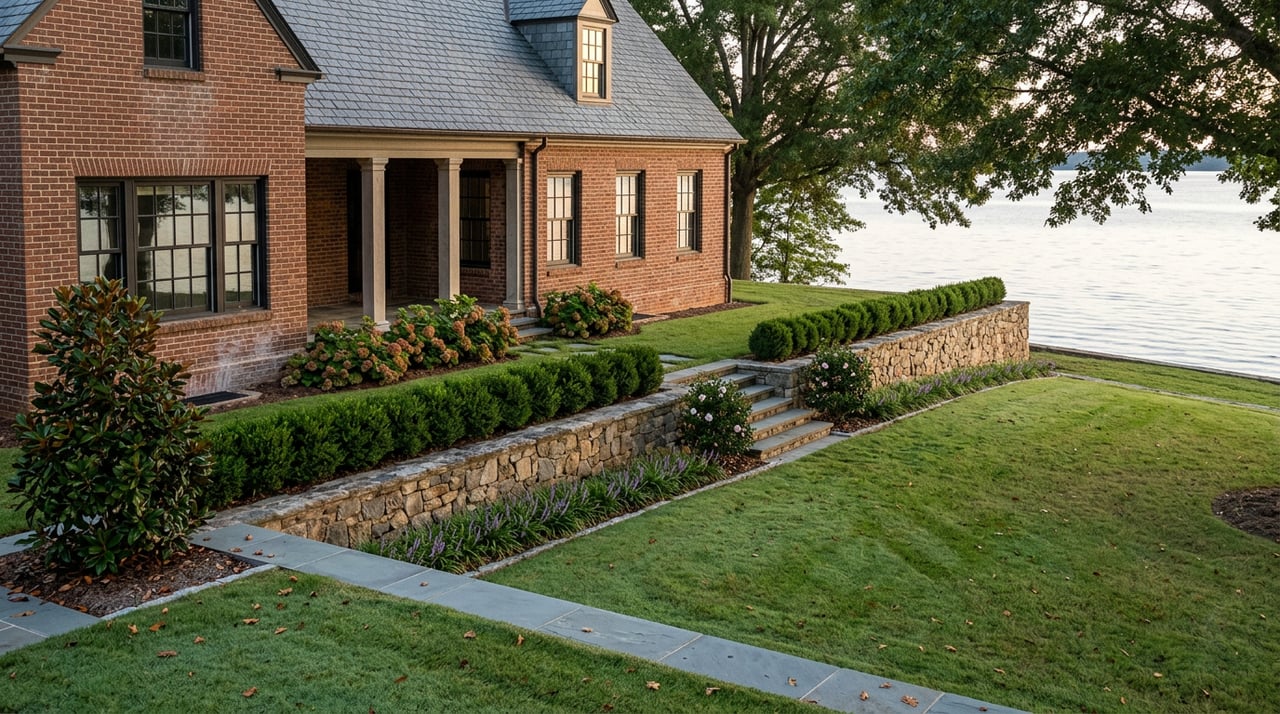
A buyer closes on a lakefront home in Cornelius. The house passes inspection. The dock sits exactly where the listing photos showed it, slip and lift both in working order, nothing flagged during the walkthrough. Weeks later, during the routine paperwork to move the dock permit into the new owner's name, a Duke Energy inspector pulls the file and finds a mismatch. A prior owner had once removed the covered roof over the slip, then put a covered structure back years later without ever resubmitting the change. Because that modification was never re-permitted, Duke requires the whole structure removed, at the current owner's cost. The house closed clean. The dock did not.
That is a documented case on Lake Norman, and the mechanics behind it apply to any waterfront purchase in Cornelius, from a starter place off West Catawba Avenue to a nine-figure estate on its own island. The house transfers with the deed. The dock runs on a separate approval that Duke Energy controls, and that approval does not move with the sale unless someone does the paperwork to move it.
The Water Below The House Belongs To Duke Energy, Not The Seller
Lake Norman is a hydroelectric reservoir. Duke Energy built it by damming the Catawba River, and the company still manages the shoreline under a federal license from the Federal Energy Regulatory Commission. A waterfront lot in Cornelius ends at the full pond elevation, known locally as the 760 line, the water surface when the lake sits at its normal full level of 760 feet above sea level. Everything below that line, including the dock, the boat lift, and any seawall or riprap, sits on land Duke owns and administers through its Catawba-Wateree Shoreline Management Program.
That single fact reframes what a dock actually is in a real estate transaction. It is not a fixture like a kitchen island or a finished basement. It is a separately permitted structure sitting on someone else's property, and the approval that governs it runs on its own timeline, with its own inspector, independent of your purchase contract.
Layer on top of Duke's review whatever else the specific parcel triggers. The North Carolina Department of Environmental Quality reviews activity inside the shoreline buffer. Any dredging or wetland disturbance can pull in the U.S. Army Corps of Engineers. Mecklenburg County Planning handles building, zoning, and floodplain requirements on the land side. None of those four processes is guaranteed to move at the same pace, and none of them is contingent on your closing date.
A Permit Is Not A Fixture
Here is the part that catches buyers off guard: Duke issues dock permits to a person or entity, not to a property. When a home sells, the permit does not automatically pass to the new owner the way title does. The seller, or the buyer, has to initiate a transfer through Duke's online Lake Access Permit System, and until that transfer is registered, Duke will not release the underlying permit record, plate photograph, or site plan to a prospective buyer. That leaves the listing side responsible for producing the paperwork, which means the sequencing has to happen before closing, not during a post-sale surprise.
Timelines vary depending on whose numbers you're reading and what the project involves. Standard dock reviews run roughly four to twelve weeks in most accounts, while other lake-services guidance puts the window closer to thirty to ninety days. Either way, anything involving NCDEQ or Army Corps review can stretch well past a typical closing calendar, and that gap matters most for a buyer planning to dredge a shallow cove or add a second slip in their first season on the water.
One more wrinkle is worth knowing if you're eyeing vacant waterfront land rather than an existing home. Effective July 1, 2026, Duke Energy stopped reviewing private dock applications on lots where no home has been built yet. If your plan is to buy raw shoreline in Cornelius and permit a dock before you build, that sequence no longer works. The house has to exist first.
Four Numbers On The Permit That Rarely Match The Listing
A listing photo shows a dock. The MLS sheet lists a slip count. The seller mentions a lift. None of that confirms what the recorded permit actually approved, and four fields are the ones most likely to diverge between the permit on file and what's sitting in the water:
- Slip count. The number of boats a permit allows and the number a dock physically holds are not always the same figure.
- Lift capacity. A lift added or upgraded after the original permit may never have been resubmitted for approval.
- Roof status. Covered slips are sometimes allowed, sometimes not, depending on the shoreline classification, and adding a roof changes how square footage gets calculated. An uncovered dock is often measured by walkable platform alone. Once it's roofed, the area underneath counts toward the total, and if the structure was already near its limit, that roof alone can push it over and trigger denial.
- Length. Dock length on Lake Norman isn't governed by one number. A structure can extend no more than whichever is more restrictive of 120 feet from the 760 line or one-third of the distance across the cove. If a boat will be moored at the end, Duke factors that boat's footprint into the calculation too, and a dock can also be shortened by its effect on a neighbor's ability to get in and out of their own slip.
A listing that promises "room to expand" the dock is describing a hope, not a fact, until Duke confirms it in writing.
Why Cornelius's Price Spread Is Really A Dock Spread
Cornelius has more Lake Norman shoreline than any other town on the lake, and its price range reflects that stretch more than almost anywhere else in the market. As of June 2026, the town's citywide median list price sat near $599,000, and a rolling three-month median through mid-August 2026 put it closer to $627,500, with the average sale price running well above the median near $1.12 million. That gap between median and average is the town telling you it isn't one market.
| Segment | What's typically included at the water |
|---|---|
| In-town condo or townhome near Antiquity | Walkable to downtown, often no private deepwater dock rights |
| Traditional subdivision off West Catawba Avenue | Mixed lake access, dock rights vary parcel to parcel |
| Deep-water estate in The Peninsula | Private dock, often multi-slip, negotiated permit history |
| A private-island estate | Its own shoreline classification, its own permit file, its own negotiation |
The broader Lake Norman waterfront market carried a median of $2,364,000 in the first quarter of 2026, and Cornelius's own top tier shows how far that range can stretch. In April 2026, a newly built estate at 20221 Regatta Island Drive came to market at $18,999,000, the highest listing price in the town's history. The home sits on its own gated 3.04-acre island with roughly 1,250 feet of shoreline and a multi-slip dock, built in 2024 after the site last sold in 2021 for about $4.35 million before redevelopment. Before this listing, most of the town's high-end sales had run between $6 million and $10 million, including an $11.5 million sale at Belle Isle Drive in 2024 that still stands as the town's highest closed transaction on record.
A house at that price carries its own dock negotiation, its own permit history, and its own shoreline classification, and that is exactly the point. The dock is never a footnote to the price. In Cornelius, it's often the reason for it.
What To Verify Before You Write Or Accept An Offer
- Confirm the dock permit is currently in the seller's name. If it isn't, the seller needs to start a transfer through Duke's Lake Access Permit System before any records can be produced, and that step needs to be built into the contract timeline rather than discovered during due diligence.
- Request the recorded permit, the plate photograph on the dock itself, and the original site plan. A plate on the structure only confirms a permit exists somewhere. Only the permit record confirms whether what's in the water still matches what Duke approved.
- Match the permit to the listing field by field. Slip count, lift capacity, roof status, and dock length are the four places a mismatch is most likely to surface.
- Get a written feasibility check from Duke before relying on any promise of future expansion, additional slips, or a shoreline modification.
None of this is unique to a particular price point. It applies at $500,000 and it applies at $18,999,000.
Frequently Asked Questions
Does a dock permit ever transfer automatically when a Lake Norman home sells? No. Duke Energy issues the permit to a person or entity, and the new owner has to register the transfer through Duke's Lake Access Permit System before the permit is considered current in their name.
How long does a dock permit review typically take? Estimates vary by source, generally landing somewhere between four weeks and three months for a standard project. Anything involving NCDEQ or Army Corps review, such as dredging or wetland impact, can extend well beyond that.
Can a grandfathered dock lose its status? Yes. A dock built under older rules can retain grandfathered status only as long as it isn't modified beyond routine maintenance. Unauthorized changes, even ones made by a previous owner, can force the entire structure into current compliance review at the new owner's expense.
Waterfront math in Cornelius rarely stops at square footage and finish level. The dock carries its own paperwork, its own timeline, and often its own share of the price. If you're buying or selling on Lake Norman and want someone who checks the permit file before the ink dries, Owning Lake Norman can walk the details with you. Schedule Your Private Consultation to start the conversation.