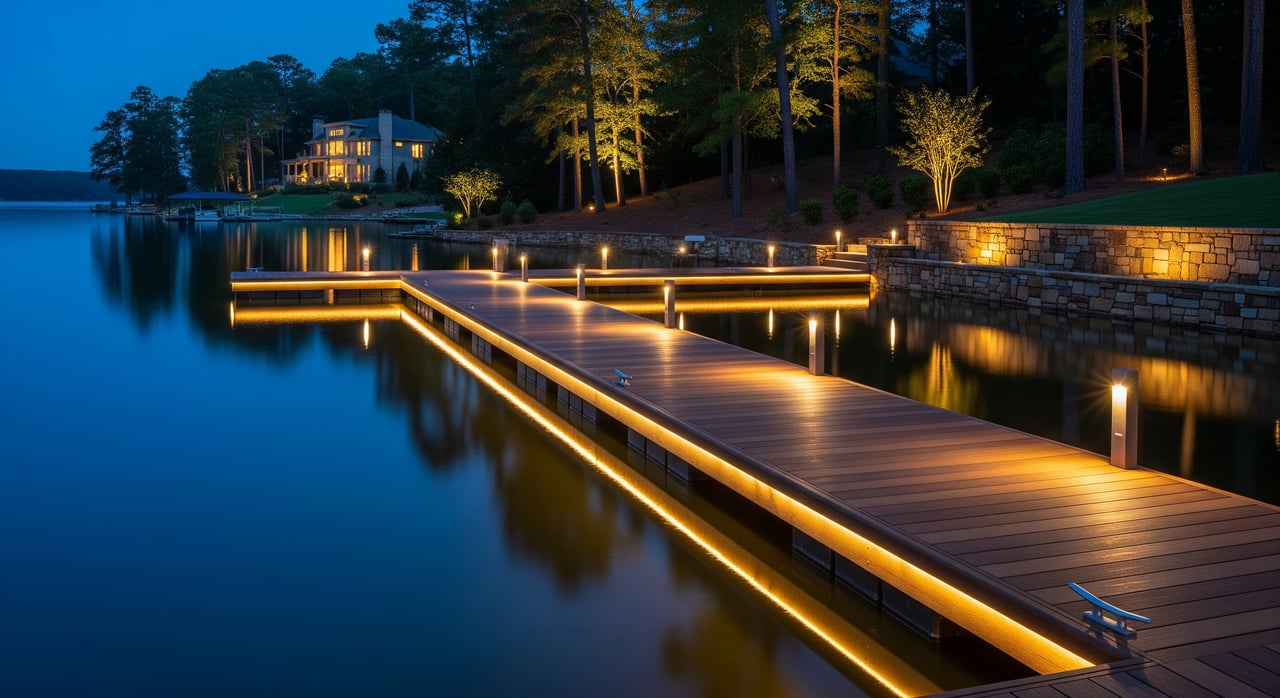
Twilight on Lake Norman is magic, but the right lighting is what makes your shoreline feel both inviting and safe. If you own a waterfront home in Catawba County, you want a solution that protects night skies, respects your neighbors, and keeps energy use low. You also want lighting that stands up to lake life without harsh glare or complicated upkeep. In this guide, you will learn how to plan efficient dock and landscape lighting that looks elegant, follows local rules, and works beautifully for showings and everyday living. Let’s dive in.
Start with permits and approvals
Before you place a single fixture, confirm the basics. Lake Norman is a Duke Energy reservoir, and dock or shoreline work often requires review through Duke Energy Lake Services under the Shoreline Management Plan. Always contact Duke Energy Lake Services early to confirm what your project needs.
Electrical work in Catawba County typically requires permits and must meet National Electrical Code requirements. Outdoor and dock circuits must have GFCI protection and proper weatherproofing. Verify details with the Catawba County building and electrical inspections office and engage a licensed North Carolina electrician for near-water work.
If your property is in an HOA community, review covenants that address light trespass and exterior aesthetics. Getting approvals in the right order saves time and avoids rework. The best approach is to check with Duke Energy, the county permitting office, and your HOA before you finalize any design.
Design for low glare and safety
Your goal is to guide the eye and the feet without washing the shoreline in light. A layered plan is the simplest way to achieve that. Use low-level step or path lights for navigation and reserve small accent beams for trees or architectural features. Keep uplighting minimal and aim fixtures toward the property rather than across the water.
Moderate the brightness. Many path fixtures work at 20 to 150 lumens each depending on spacing. For dock edges and steps, 10 to 50 lumens is often enough. Less light, placed well, usually improves safety and looks more refined on the lake.
Choose warm color temperatures to reduce glare and blue-rich light. A range of 2200K to 3000K is ideal, with 2700K as a common sweet spot. Near the waterline, amber or warm amber options can further reduce ecological impact. Aim for a CRI of 80 or higher so surfaces and finishes read as they do in daylight.
Fixture types that perform on the lake
- Dock-rated step or toe-kick lights with diffused lenses to hide bright points.
- Post-cap lights with full cutoff optics that shield the source from view.
- In-grade or low bollard path lights with frosted lenses to prevent sparkle or glare.
- Under-dock or underwater lights used with caution. They can affect aquatic behavior and may be restricted. If you include them, choose submersible-rated fixtures and plan for extra maintenance.
Materials and protection that last
Waterfront conditions call for durable construction. Above-water fixtures should be at least IP65 for dust and water jet protection. Submersible uses require IP67 or IP68. Look for 316 stainless steel, bronze, UV-stabilized plastics, or well-coated aluminum. Avoid ordinary steel or low-grade metals near the waterline.
Use shields, louvers, and frosted lenses to control glare and protect lake views. Mount accent lights low with tight beam spreads so you illuminate the subject, not the horizon.
Power, wiring, and smart control strategies
Low-voltage LED systems at 12 or 24 volts are common for docks and landscapes. They lower shock risk and simplify runs to small fixtures. Long runs can suffer voltage drop, so share load details with your electrician and let them size the cable and transformer. Keep transformers and drivers onshore in dry, accessible locations whenever possible.
Line-voltage circuits at 120 volts can be used for higher loads where permitted. These require strict GFCI protection, weatherproof enclosures, and professional installation. All dock wiring should be secured in appropriate conduit or raceways and installed to code.
Smarter controls, lower energy
- Astronomical timers or photocontrols can turn lights on at dusk and off at dawn without manual input.
- Dimming schedules are powerful. Try full output for the first one to two hours after dusk, then dim to 20 to 30 percent overnight.
- Motion sensors on seldom-used paths or dock approaches can light only on approach.
- Zoning lets you separate shoreline accents, dock safety lights, and path lights. You can then adjust brightness and runtime for each zone.
- For remote control, consider Z-Wave, Zigbee, or Wi-Fi controllers housed in weatherproof enclosures onshore. Geofencing and app schedules can automate lighting for showings or guests.
Solar and surge considerations
Solar can work well for low-power path or accent lighting, especially in areas that are hard to wire. Seasonal sunlight and shading will affect performance, so size panels and batteries accordingly. On docks, solar can support a few small fixtures but may be less reliable if panel space is limited.
Lakeside settings are vulnerable to lightning. Include surge protection devices at the source and consider inline protection for drivers and controllers. This small investment reduces the risk of equipment failures.
A quick energy snapshot
LED upgrades can cut consumption dramatically. Replacing a 50 watt halogen with a 5 to 10 watt LED often yields an 80 to 90 percent reduction. For example, 10 path lights at 5 watts each draw 50 watts total. At 5 hours per night, that is about 0.25 kWh per night, roughly 91 kWh per year, which is a very modest load.
Protect wildlife and preserve the night
Lake Norman’s beauty includes its night sky and the life around it. Reduce blue-rich light and avoid high-intensity fixtures near the water to limit effects on fish, insects, and nocturnal animals. Warm or amber spectra, shielded fixtures, and careful aiming help a lot.
Limit run times to cut exposure. Schedules and dimming are simple ways to reduce light throughout the night while keeping paths and edges safe. Underwater or nearshore lighting can attract fish and insects and may increase algal growth in some conditions. Check with Duke Energy and local lake authorities before adding any underwater lighting.
Safety and maintenance that pay off
Focus light where people walk and step. Illuminate dock edges, steps, land-to-dock transitions, and any water access points. Keep lighting gentle and consistent to avoid blinding hotspots that reduce depth perception. Secure and cover wiring to prevent tripping and exposure to water.
LED fixtures can last 25,000 to 50,000 hours, but life depends on heat management and driver quality. Plan a simple maintenance routine. Clean lenses, remove debris, and inspect seals and wiring. Test GFCI and surge protection annually, and use tamper-resistant fasteners where fixtures are exposed.
Seasonal care matters. Winterize solar batteries, check for freeze and thaw impacts, and secure any loose fixtures before major storms. Budget for small replacements like gaskets or sealing plugs every few years to keep systems tight and reliable.
Professional installation and documentation
Near-water electrical work deserves expert hands. Hire a licensed electrician with marina or dock experience and familiarity with local requirements and Duke Energy coordination. After installation, request a final inspection and a simple diagram of the system. Good documentation makes future maintenance easier and supports clear real estate disclosures when you sell.
Seller and year-round owner tips
- For twilight showings, set an astronomical timer and program a temporary full-brightness window in the early evening. Keep safety lights on a separate zone so paths and steps are always clear.
- For everyday living, lean on dimming and motion sensing. Most nights do not need full output for every zone.
- Use warm or amber LEDs at the shoreline, shield optics, and aim lights toward your property. Your views and your neighbors will thank you.
Quick planning checklist
- Permissions and approvals
- Confirm Duke Energy shoreline or dock permit status.
- Verify Catawba County electrical permits and inspections.
- Review HOA rules for exterior lighting.
- Safety and code
- Use a licensed electrician for all dock and near-water work.
- Ensure GFCI protection and surge protection are installed.
- Fixture specifications
- LED, warm white 2200K to 3000K or amber near the shoreline.
- IP65 or higher above water, IP67 or IP68 for submersible.
- Marine-grade materials like 316 stainless, bronze, or UV-stable plastics.
- Shielded, full cutoff optics, and dimmable drivers.
- Power and controls
- Astronomical timer and dimming schedules with zones.
- Motion sensors for low-traffic areas.
- Reliable controllers in weatherproof onshore enclosures.
- Energy and maintenance
- Choose long-life LEDs, include surge protection, and schedule yearly checks.
- Ecology and neighbor relations
- Favor low-glare solutions, aim toward shore, limit blue light, and keep overnight levels low.
When your dock and landscape lighting is planned with intention, you get a shoreline that feels safe, looks refined, and respects the lake. Done right, it is a subtle upgrade that highlights your home’s best features while keeping energy use and maintenance low.
Ready to elevate your waterfront presentation or prepare for market with a thoughtful lighting plan? Connect with Unknown Company to Schedule Your Private Consultation.
FAQs
Do you need permits for dock lighting on Lake Norman?
- Yes. Coordinate with Duke Energy Lake Services for shoreline or dock work, verify electrical permits with Catawba County, and review any HOA rules before you begin.
What color temperature is best for shoreline lighting on Lake Norman?
- Use warm white LEDs between 2200K and 3000K, and consider amber near the water to reduce blue light, glare, and ecological impact.
Are underwater lights recommended for Lake Norman docks?
- Use caution. Underwater lights can affect aquatic behavior and may be restricted, so check with Duke Energy and plan for more maintenance if you include them.
How bright should path and dock edge lights be for safety?
- Many path lights perform well at 20 to 150 lumens and dock edges or steps at 10 to 50 lumens; use shields and careful aiming to avoid glare.
What wiring and safety features should a dock lighting system include?
- Install to National Electrical Code standards with GFCI protection, secure wiring in appropriate conduit, surge protection, and drivers placed onshore when possible.
Can solar power my dock lighting reliably?
- Solar can work for low-power path or accent lights, but docks may have limited panel space and shading; size panels and batteries for seasonal conditions.